1929
Liquidity → Solvency
A credit system that priced uncertainty at zero discovered, in October, that the variable existed.
Solstice Laboratory · Spring 2026 · First Edition
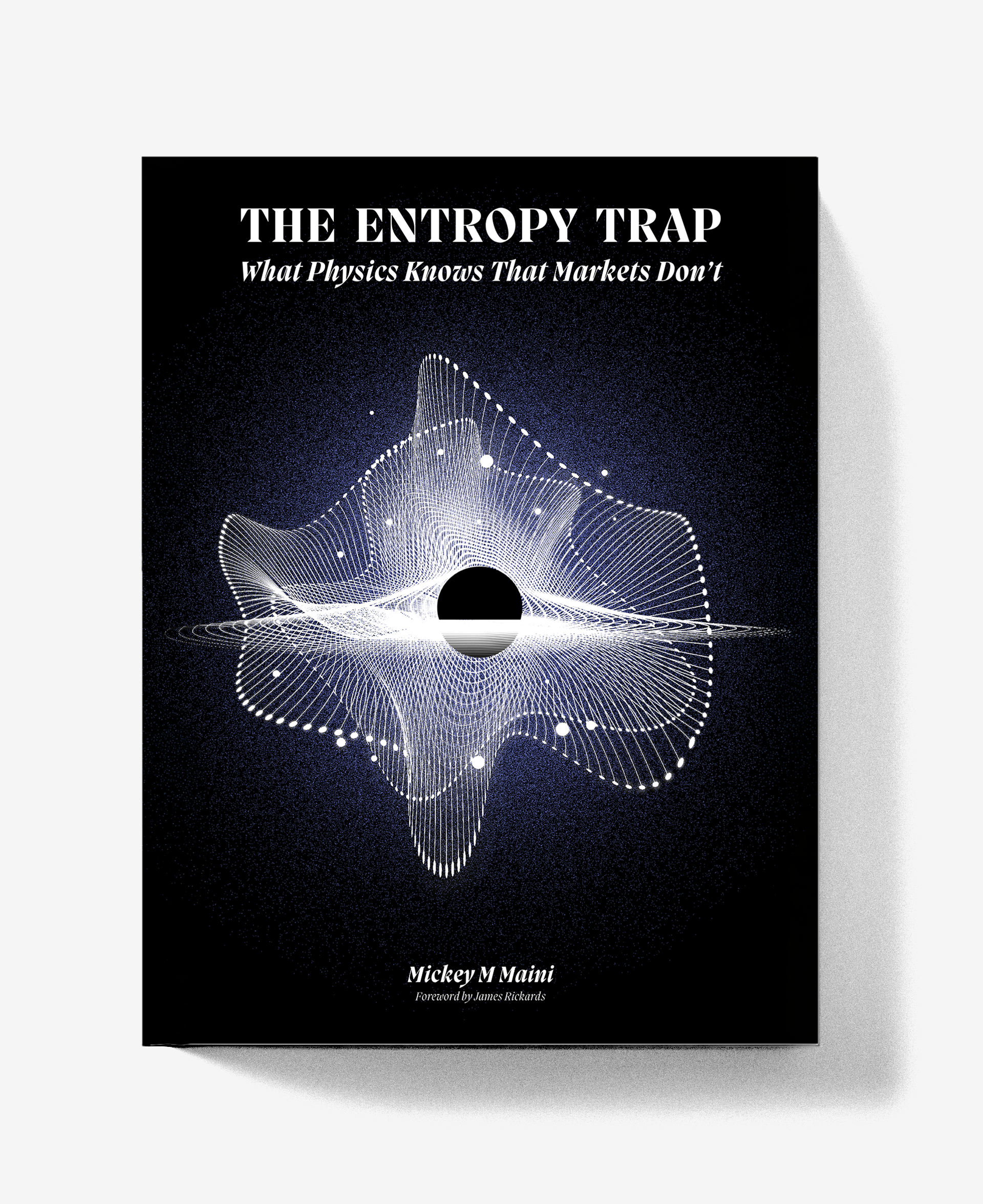
What physics knows that markets don't.
Most of the time, markets behave the way models say they should. Capital flows, prices clear, expectations adjust. Then, occasionally — and always at the wrong moment — something breaks. The standard tools no longer describe what is happening. The system has crossed a threshold that the equations did not see.
The Entropy Trap is a book about those thresholds: where they come from, why they arrive without warning, and what the language of physics has to say about systems that suddenly stop behaving like themselves.
We are repeatedly blindsided not because the data is unclear but because we are looking at the wrong variables, with the wrong instruments, in the wrong frame.
This book proposes a different frame. It borrows the kinematic vocabulary of statistical mechanics — entropy, phase space, order parameters, criticality — and applies it to the economic and geopolitical systems that produce the conditions we live inside.
It is not a forecast. It is a way of reading the temperature of a world that keeps boiling without telling us first.
Four moments where the models worked — until they didn't. The book reads each one with the instruments of physics, not economics.
1929
Liquidity → Solvency
A credit system that priced uncertainty at zero discovered, in October, that the variable existed.
1971
Anchor → Drift
Bretton Woods did not collapse. It dissolved — the substrate beneath every price quietly stopped existing.
2008
Diversification → Coupling
Risks held to be independent revealed themselves to share a single underlying state.
2026
Order → Phase
The next transition is already in motion. The instruments are still pointed at the last one.
Every framework that has ever surprised us did so for the same reason: it was correct, until it wasn't. Linear models keep working until the system they describe stops being linear. The danger is not that we use the wrong tool. The danger is that the tool keeps producing plausible answers long after it has stopped describing reality.
This is the trap. Confidence is highest at exactly the moment understanding has begun to fail. The data still flows, the dashboards still light up, the variance still looks bounded — and the floor has already moved.
Warning.
The book is not a manual for predicting the next crisis. It is an argument for changing what you measure, before the measurement itself becomes the source of error.
Order
Available April 2026.
First edition published by The Solstice Laboratory. 240 pages, with a dashboard companion and the framework's reading guide for the Long Now.